
| Who is at fault when a driver hits a cyclist in Brea? Fault depends on the circumstances of the crash, including whether the driver followed California’s rules for safely passing a bicyclist. California Vehicle Code §21760 generally requires a driver overtaking a bicycle to change lanes when reasonably possible and safe or leave at least three feet of clearance when passing. A Brea bicycle accident lawyer can examine the Brea Police Department collision report, photographs, available video, witness statements, vehicle damage, and other evidence to determine how the crash happened and whether the driver or another party may be responsible. |
Bicycle claims differ from ordinary car accident claims in three important ways. A rider has no vehicle frame for protection, so injuries are often more serious. Fault is more often disputed, with questions about helmets, lights, and lane position. Coverage may also come from more than one source, including the rider’s own auto policy. Our Brea office handles these claims for riders throughout North Orange County.
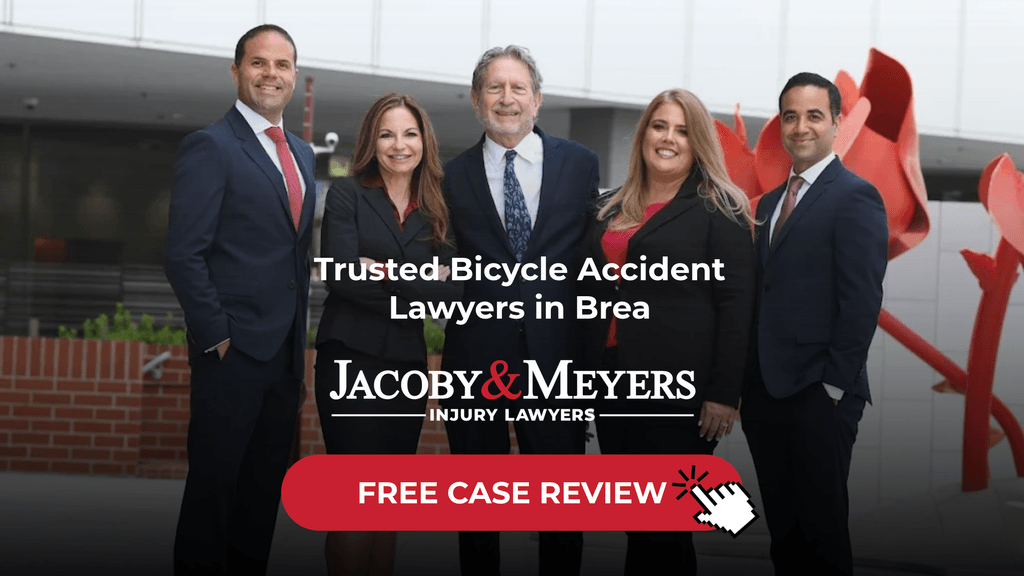
Jacoby & Meyers has represented injured Californians since 1972. For more than 50 years, our firm has been guided by one belief: hardworking families deserve quality legal representation when someone else’s carelessness disrupts their lives. Today, that belief guides our team at our Brea office on State College Boulevard.
More than $2 billion recovered. Our verdicts and settlements include more than $2 billion recovered for injured clients across California, including a $17.5 million result for a cyclist struck by a truck.
Lasting client relationships. Client reviews describe regular case updates, answered questions, and help arranging medical treatment during recovery.
Experience across roadway claims. Our team handles bicycle claims alongside other motor vehicle cases, and our car accident lawyers bring the same evidence and insurance experience to your claim.
You come first. Consultations are free and available 24/7 through our contact page, and you pay no attorney fees unless we recover compensation for you.
Our awards and affiliations reflect the standards we bring to your first conversation and to every step after it. Let us guide you all the way.
Past results depend on the facts of each case. They do not guarantee, warrant, or predict the outcome of your legal matter.
What should you do immediately after a bicycle accident in Brea?
After a crash, your first priorities are to get medical care, call the police so a collision report is created, and preserve evidence of the scene and your bicycle. These three steps protect your health and the facts of your claim while they are still clear.
Protect Your Health
Your well-being comes first. If you or anyone else is seriously hurt, call 911. Riders have no seatbelt, airbag, or vehicle frame for protection, so even a low-speed impact can cause a fracture or head injury that is not obvious at the scene. If you decline an ambulance, see a doctor the same day. A prompt medical record also connects your injuries to the crash.
Protect Your Evidence
The details of a bicycle crash can disappear quickly once vehicles are moved and the contact details of any witnesses are lost.
- Collect the driver’s name, insurance information, and the contact details of any witnesses.
- Keep your bicycle, helmet, and clothing in their current condition, because damage patterns can show how the impact happened.
- Note any nearby businesses or homes with cameras that may have recorded the crash.
Protect Your Future
Ask the responding officer for the report number before you leave. Before you give a recorded statement to the driver’s insurance company, consider speaking with an attorney who can help you understand how your words may be used. You may also want to notify your own auto insurer, because your policy may provide coverage even though you were on a bicycle.
What actually happens after a bicycle crash is reported in Brea?
Once a crash is reported, the responding agency documents the scene, and that report becomes one of the first documents an insurer reviews. Which agency responds depends on where you were riding.
The Brea Police Department Traffic Division investigates collisions on city streets such as Imperial Highway, State College Boulevard, and Brea Boulevard. The California Highway Patrol generally handles crashes on SR-57 and in unincorporated areas, such as Brea Canyon Road north of the city. Knowing which agency responded tells us where your report and scene photographs are held. Brea collision reports are requested through the Police Records Division at 1 Civic Center Circle using the department’s Request for Release of Records Information form.
What causes bicycle accidents in Brea?
Bicycle crashes in Brea commonly involve a driver who does not see, yield to, or give adequate space to a rider. Each cause below connects to a specific rule or roadway condition:
- Unsafe passing. A driver passes without changing lanes or without leaving three feet of clearance, which violates Vehicle Code § 21760. The risk is greatest on two-lane stretches of Carbon Canyon Road.
- Right-hook turns. A driver turns right across a rider who is traveling straight, a risk at busy intersections such as Imperial Highway and State College Boulevard.
- Left-turn collisions. A driver turns left in front of an oncoming cyclist whose speed or distance the driver misjudged.
- Dooring. A driver or passenger opens a car door into traffic when it is not reasonably safe, which Vehicle Code § 22517 prohibits. Downtown parallel parking creates this risk.
- Distracted driving. A driver who is looking at a phone or navigation screen may not see a rider entering the street from The Tracks at Brea.
- Road hazards. Potholes, uneven pavement, or debris can force a rider to swerve or fall.
- Defective equipment. A brake, frame, or e-bike battery defect can cause a crash or make its injuries worse.
What injuries are common after a bicycle accident in Brea?
Bicycle accidents commonly cause head injuries, fractures, spinal injuries, and severe road rash. Because a rider absorbs the full force of an impact and then strikes the pavement, injuries are often more serious than they first appear.
- Traumatic brain injuries, which can occur even when a rider wears a helmet
- Collarbone, wrist, hip, and leg fractures, some requiring surgery
- Spinal cord and back injuries that can cause chronic pain or paralysis
- Road rash that can become infected or leave permanent scarring
- Facial fractures and dental injuries
- Internal bleeding that may not show symptoms right away
Each injury is documented differently. A brain injury may require neuropsychological testing, while a fracture is documented through imaging and surgical records, and that documentation becomes the basis for valuing your claim. Serious injuries in North Orange County are often treated at UCI Health – Orange, which is home to the county’s only Level I adult trauma center.









Who can be held responsible for a bicycle accident in Brea?
More than one party may share responsibility for a bicycle crash, depending on who was driving, who owned the vehicle, and who maintained the road. Identifying each responsible party can affect the total compensation available to you.
- Negligent drivers. A driver may be responsible for passing unsafely, failing to yield, turning across your path, or driving while distracted.
- Employers and vehicle owners. When a driver was working at the time of the crash, such as during a delivery, the employer’s insurance may also apply.
- The person who opened a door. A driver or passenger who opens a door into your path may be responsible under Vehicle Code § 22517.
- Public entities. The City of Brea, the County, or the State may share responsibility when a dangerous road condition contributed to the crash. Caltrans maintains Carbon Canyon Road as State Route 142, while the City maintains most other Brea streets.
- Manufacturers. A bicycle or component maker may be responsible when a defective brake, frame, or battery caused or worsened the crash.
How do you prove a driver was negligent?
To prove a driver was negligent, you generally need to show that the driver owed you a duty of reasonable care, failed to act as a reasonably careful driver would, and that the driver’s conduct caused your injuries and losses. California Civil Code §1714 establishes the general duty to use ordinary care to avoid causing injury to others.
California law also gives bicyclists important protections on the road. Under Vehicle Code §21200, bicyclists generally have the same rights and are subject to the same provisions applicable to drivers of vehicles, subject to specific exceptions. This means a driver cannot simply assume a cyclist has fewer rights to the roadway.
Evidence can help show how the crash happened. A Brea bicycle accident lawyer may review the police report, photographs, traffic-camera or surveillance footage, witness statements, vehicle damage, road conditions, and medical records to establish what the driver did and how it caused your injuries.
When a Driver Violates a Traffic Law
A violation of a traffic safety statute can provide important evidence of negligence. Under California Evidence Code §669, a violation of a statute or regulation may be presumed to constitute negligence when specific legal conditions are met, including that the law was intended to prevent the type of harm that occurred and the injured person was among those it was intended to protect.
For example, a driver’s violation of a law governing how motorists pass bicyclists or open vehicle doors near cyclists may become significant evidence in a claim. Our attorneys can examine the traffic law, the facts of the collision, and the available evidence to determine how the driver’s conduct may support your case.
Attorney Insight: How California’s passing rule works on Brea roads
California’s rule for passing a cyclist is found in Vehicle Code § 21760. Since January 1, 2023, when Assembly Bill 1909 took effect, what a driver must do depends on the road:
- If there is a second lane going the same direction, as on Imperial Highway, the driver must move into that lane to pass, as long as it is safe and legal to do so.
- If there is no second lane, as on the two-lane stretches of Carbon Canyon Road, the driver must leave at least three feet between the car and the rider, about the width of an open car door.
- If traffic or the road makes three feet impossible, the driver must slow down and wait to pass until it is safe for the rider.
Before 2023, the rule centered on three feet of space, and that distance is hard to measure after a crash. On a road like Imperial Highway, the question is now simpler: did the driver move over? Video and the location of damage on the vehicle and bicycle often answer that question, which is why we request footage early.
What compensation might you recover after a Brea bicycle accident?
Under California Civil Code §§ 3281–3294, you may recover economic damages, non-economic damages, and, in rare cases, punitive damages. The value of your claim depends on how the crash has affected your health, your income, and your daily life.
Economic Damages
Economic damages are losses with a clear dollar value, including:
- Past and future medical expenses, including surgery, rehabilitation, and medication
- Lost wages during your recovery
- Reduced earning capacity if your injury affects your ability to work long term
- Repair or replacement of your bicycle, helmet, and riding equipment
Non-Economic Damages
Non-economic damages account for the personal effects of your injury that do not come with a receipt, including:
- Physical pain and suffering
- Emotional distress
- Loss of enjoyment of activities, including riding
- Scarring and disfigurement
Legal Tip from Our Attorneys
California law does not always require a cyclist to ride at the right edge of the road. Under Vehicle Code § 21202, a rider who is moving slower than traffic generally stays as far right as practicable. The rider may move left, however, to pass, to prepare for a left turn, or to avoid hazards, including a lane that is too narrow for a car and a bicycle to share side by side safely.
This matters on roads like Carbon Canyon Road, where narrow lanes and tight curves can leave no safe room to share. A rider who moves toward the center of the lane there may be following the law, not breaking it. An insurer may suggest that a rider “should have stayed to the right,” so we compare the lane width, the road conditions, and the scene evidence with what § 21202 actually allows.
If some fault is still assigned to you, California’s pure comparative fault rule reduces your recovery by your share of fault rather than eliminating it.

Trust Jacoby & Meyers to Handle Your Case
When must you file a bicycle accident claim in Brea?
In California, you usually have two years from the date of the crash to file a lawsuit against a negligent driver under Code of Civil Procedure § 335.1. Missing this deadline can prevent you from recovering compensation, so we confirm which deadline applies to your claim at the outset.
Certain circumstances can change this deadline, including:
- Injured minors. If the injured rider is under 18, the filing period may begin later.
- An unavailable defendant. If the at-fault driver leaves California, the deadline may be paused.
- Claims against a public entity. A much shorter deadline applies, as explained below.
Pitfall Alert: What if a road defect contributed to your crash?
If a pothole, broken pavement, or missing signage on a public road contributed to your crash, the two-year deadline does not control that part of your claim. Under Government Code § 911.2, a written claim against a public entity generally must be presented within six months.
- Claims against the City of Brea are presented through the City Clerk’s Office, and the City provides written notice of its decision within 45 days.
- Claims involving a state highway, such as Carbon Canyon Road, are presented through the State’s Government Claims Program.
Many riders focus only on the driver and learn about a road-condition claim after the six-month window has closed. Our attorneys review the roadway at the start of your case, so that each available claim is identified while it can still be filed.
What if your bicycle has already been repaired or discarded?
Many riders repair or replace a damaged bicycle soon after a crash, which is understandable. The damage pattern on a frame, wheel, or helmet can show the direction and force of an impact, so the bicycle is often useful evidence. If you still have it, keep it in its current condition and photograph it before any repair. If it has already been repaired, keep the repair invoice and any photos, and our team can work with the shop’s records and other evidence to reconstruct what happened.
Why should you hire a lawyer instead of dealing with the insurer alone?
Insurance companies rely on trained adjusters and attorneys to evaluate each bicycle accident claim. A Brea bicycle accident lawyer brings the same preparation to your side, so that your claim is judged on its full merits.
What you handle: Focus on your recovery, attend your medical appointments, follow your providers’ recommendations, and keep copies of bills, records, and other documents related to your injuries. Before making important decisions about your claim, your attorney can explain your options and the potential consequences.
What your attorney handles: Your legal team can obtain the collision report, gather photographs and other scene evidence, identify available video and witness information, determine which parties and insurance policies may be involved, and document your economic and non-economic losses. Your attorney can also communicate with the insurance company and negotiate on your behalf. If the parties cannot reach a fair resolution, your lawyer can explain the next steps, including preparing the case for litigation.
Throughout the process, you should know what is happening with your claim and why. Our attorneys keep you informed while handling the legal details, so you can focus on your recovery.
What to Expect From the Insurance Company
Insurance companies review several questions before they evaluate a bicycle claim. Knowing them in advance helps you understand how your claim will be assessed:
- Was a helmet required, and would it have changed the injury? California requires helmets only for riders under 18 under Vehicle Code § 21212. A helmet question may bear on a head injury, but it has no bearing on a fractured leg or road rash.
- Where was the rider positioned on the road? Adjusters may ask whether a rider moved into the driver’s path. The location of vehicle damage and scene evidence often answer this question.
- Did speed play a role? On downhill stretches of Carbon Canyon Road, insurers may examine the rider’s speed as well as the driver’s.
- Does an early offer reflect the full claim? Offers made before treatment is complete usually require a release that waives unknown future claims under Civil Code § 1542.
Our response is the evidence. We gather the records that address each question and explain every offer to you before you decide.
Legal Complexity: What adds weight to bicycle claims
Several legal questions carry added weight in bicycle claims:
- Passing distance and lane position are harder to reconstruct. Unlike a typical rear-end collision, a passing crash often requires video or expert analysis to show where each party was.
- Multiple defendants divide damages differently. Under Civil Code § 1431.2, each defendant may be responsible for all economic damages but only its own share of non-economic damages.
- Public roads bring separate rules. A road-condition claim requires proof of a dangerous condition under Government Code § 835.
- Electric bicycles raise classification questions. The class of e-bike, its speed, and Brea’s local rules, including its restriction on riding e-bikes on sidewalks, can affect the fault analysis.
Our team manages each of these questions on your behalf and explains how they affect your claim.
Litigation Readiness: Preparing for the Next Stage
Many bicycle claims resolve through settlement, but we prepare each case with trial in mind, and we explain every stage to you before it begins. That preparation includes:
- Evidence preservation. We send preservation requests for video, vehicle data, and phone records, and we keep your bicycle and helmet in their post-crash condition.
- Expert coordination. We work with accident reconstructionists, bicycle mechanics, and medical specialists who can explain how the crash happened and how your injuries will affect your future.
- Trial readiness. We organize the evidence, witnesses, and damages documentation needed to present your case at the Central Justice Center in Santa Ana if a fair settlement is not offered.
What does the claims process look like from start to finish?
Most bicycle accident claims move through four steps. The length of each step depends on your medical treatment and how the insurers respond, and we keep you informed throughout.
Step 1: Case evaluation. Our attorney reviews the circumstances of your crash, explains the strengths of your claim, and outlines how we recommend approaching it. This consultation is free, and you can reach our team 24/7 to schedule it.
Step 2: Investigation. In the first weeks, we request the Brea Police Department or CHP report and preserve video and witness statements. This step continues while you receive medical treatment, which often takes several weeks to several months.
Step 3: Negotiation. Once your treatment is complete, or your doctors can estimate your future care, we present your claim to the insurer and negotiate for a fair settlement.
Step 4: Settlement or litigation. Many cases settle. If a fair settlement is not offered, your case may proceed to litigation at the Central Justice Center in Santa Ana, which extends the timeline. We explain each stage of that process before it begins.
How Do You Choose the Right Bicycle Accident Lawyer in Brea?
Choosing a bicycle accident lawyer is about more than finding a firm that handles personal injury claims. Look for a team with relevant case experience, the resources to investigate and prepare your claim, a clear process for communication, and fee terms you understand before you begin.
When comparing lawyers, consider asking:
- Have you handled bicycle accident cases like mine? Ask about the types of bicycle claims the firm handles and whether it has experience with serious or complex injuries. Jacoby & Meyers reports more than 50 years of representing injured Californians and lists a $17.5 million bicycle-versus-truck recovery involving paraplegia among its case results. Past results depend on the facts of each case and do not guarantee a similar outcome.
- Who will handle my case? Find out who will investigate your accident, communicate with the insurer, and guide your claim through settlement or litigation. Jacoby & Meyers has a statewide team of attorneys and case managers, with 14 California office locations, including a Brea office.
- How will you investigate my accident? Bicycle cases can depend on photographs, witness accounts, traffic laws, medical records, video, and other evidence. Ask whether the firm has the resources to gather and preserve that evidence and determine how the collision occurred. Jacoby & Meyers states that its personal injury attorneys assist with proving negligence, gathering evidence, negotiating claims, and preparing cases for litigation.
- What will I pay? Ask for a clear explanation of attorney fees and case costs before hiring a firm. Jacoby & Meyers handles bicycle accident cases on a contingency-fee basis, meaning attorney fees depend on recovering compensation, with the terms explained during the consultation. The firm also offers free consultations.
- Can you prepare my case for trial if necessary? A lawyer should be able to explain what happens if negotiations with the insurance company do not resolve your claim. Ask about the firm’s experience with litigation and who would handle that stage of the case. Jacoby & Meyers describes its services as including insurance negotiation, settlement representation, and trial litigation.
You can meet the Jacoby & Meyers attorneys and learn more about the firm’s experience before deciding whether its approach is right for your case.
What Our Clients Say
“I had a great experience with Jacoby & Meyers. From the initial consultation to the final resolution of my case, the team was professional, responsive, and genuinely cared about my situation. They took the time to explain every step of the process, which really eased my concerns. I felt well-supported and informed throughout. Highly recommend their services! Thanks mostly to Bernabe Amanda. He was super fast and super responsive.”
Dario Damiani
“Jacoby and Meyers handled my case very well. They are, on the one hand, attending to all my needs from the first day of my injury to the details of my car accident, and setting me up for my doctor’s appointment and therapy; they did a great job. Not to mention Jocelyn Cruz, who helped me a lot to get treatment for my recurring hip injury. I am so thankful to her and to all the staff who handled my case, Cole, who first took my report, and everyone else involved in my case.”
Janet Atienza
“I would like to send a huge thank you to Isabella (case manager), who has been handling my case for a few months. I was in a car accident last December, and I didn’t know what to expect. I’m so grateful to have been able to connect with her. She communicated the entire process and answered all questions about the situation. Her customer service is consistently outstanding, exceeding my expectations every time. I have been completely impressed with her professionalism and prompt response. Thank you.”
Ana Avalos
Disclaimer: Testimonials are voluntary statements from former clients. They are not intended to create expectations about outcomes and should not be interpreted as a guarantee of results.

Schedule a Free Consultation Today
Jacoby & Meyers
Is Here
To Support You
Results for Injured Cyclists
Over more than 50 years, our team has recovered more than $2 billion for injured Californians. Our results for riders include:
- $17.5 Million: Bicycle v. truck, resulting in paraplegia
- $1.4 Million: Bicyclist v. Auto (final settlement; pre-trial offer of $351,000)
Disclaimer: Past results do not guarantee future outcomes. Results are based on the specific facts of each case.
Communities We Serve
Our Brea office serves injured riders throughout Brea and north Orange County. We also represent clients in communities across California, including:
If your crash happened elsewhere in California, see our full list of areas we serve.
Helpful Local Resources After a Bicycle Accident in Brea
Trauma Center
- UCI Health – Orange (Level I Adult Trauma Center) – 101 The City Drive South, Orange, CA 92868
Emergency Rooms
- Providence St. Jude Medical Center – 101 E. Valencia Mesa Drive, Fullerton, CA 92835
- UCI Health – Placentia Linda Emergency Department – 1301 N. Rose Drive, Placentia, CA 92870
Urgent Care
- Brea Urgent Care – 395 W. Central Avenue, Brea, CA 92821
Local Police
- Brea Police Department – 1 Civic Center Circle, Brea, CA 92821 (Traffic Division: 714-990-7640)
Local Courthouses
- North Justice Center – 1275 N. Berkeley Avenue, Fullerton, CA 92832
- Central Justice Center – 700 Civic Center Drive West, Santa Ana, CA 92701
- The Tracks at Brea Trail – City of Brea trail information and map
Disclaimer: We do not endorse these organizations or profit from listing them on our website.
Frequently Asked Questions
What should I bring to my consultation with a Brea bicycle accident lawyer?
Bring the Brea Police Department report number, photos of the scene and your injuries, medical records, the driver’s insurance information, and your bicycle or photos of it. Your Brea bicycle accident lawyer uses these records to confirm your filing deadline, which is usually two years under Code of Civil Procedure § 335.1.
What if the driver who hit me in Brea drove away?
A driver who leaves an injury crash violates Vehicle Code § 20001, but you may still recover compensation. If the driver is never identified, your own uninsured motorist coverage may apply to you as a cyclist. A Brea bicycle accident lawyer can review your policy and confirm the crash was reported to the Brea Police Department.
Can I still recover compensation if I was riding an e-bike in Brea?
Yes. E-bike riders may pursue a negligence claim under California Civil Code § 1714 in the same way as other cyclists. Insurers may raise Brea’s local e-bike rules, such as the sidewalk restriction, but a Brea bicycle accident lawyer can show whether that rule had any connection to how the crash happened.
I was hit while crossing from The Tracks at Brea. Who is at fault?
Fault depends on the signals, signage, and right-of-way where the trail meets streets such as Brea Boulevard and State College Boulevard. Drivers must use reasonable care under Civil Code § 1714, even when a rider enters from a trail. A Brea bicycle accident lawyer often uses signal timing records and video to resolve these questions.
What if an OCTA bus hit me while I was riding in Brea?
The Orange County Transportation Authority is a public agency, so a written claim generally must be presented within six months under Government Code § 911.2 before a lawsuit can be filed. A Brea bicycle accident lawyer can identify the correct agency, request bus video, and present the claim on time.
How long does a bicycle accident case usually take to resolve?
Many bicycle accident claims resolve within several months to about a year, depending on your treatment and the number of parties involved. A Brea bicycle accident lawyer can expect a longer timeline when a claim involves the City of Brea, because a public entity has 45 days to act on a claim under Government Code § 912.4.
Talk to a Brea Bicycle Accident Lawyer Today
If you were injured in a bicycle accident in Brea, our team can take on the legal work while you focus on your recovery. We will review what happened, confirm which deadlines apply to your claim, and explain your options in a free consultation. We are here to protect your recovery, your comfort, and your peace of mind.
Call our Brea office or visit our contact page to schedule your free consultation. If you decide to move forward, we will begin preserving evidence and handling communication with the insurer on your behalf.
Attorney Review & Office Information
This content has been reviewed by California-licensed attorneys at Jacoby & Meyers to ensure accuracy and compliance with applicable California law. Legal services are provided by attorneys licensed to practice in the State of California. This page is for general information only and does not constitute legal advice.
Jacoby & Meyers Accident & Injury Lawyers – Brea
135 S. State College Blvd., Suite 200, Brea, CA 92821, United States
Phone: (714) 597-6632


